
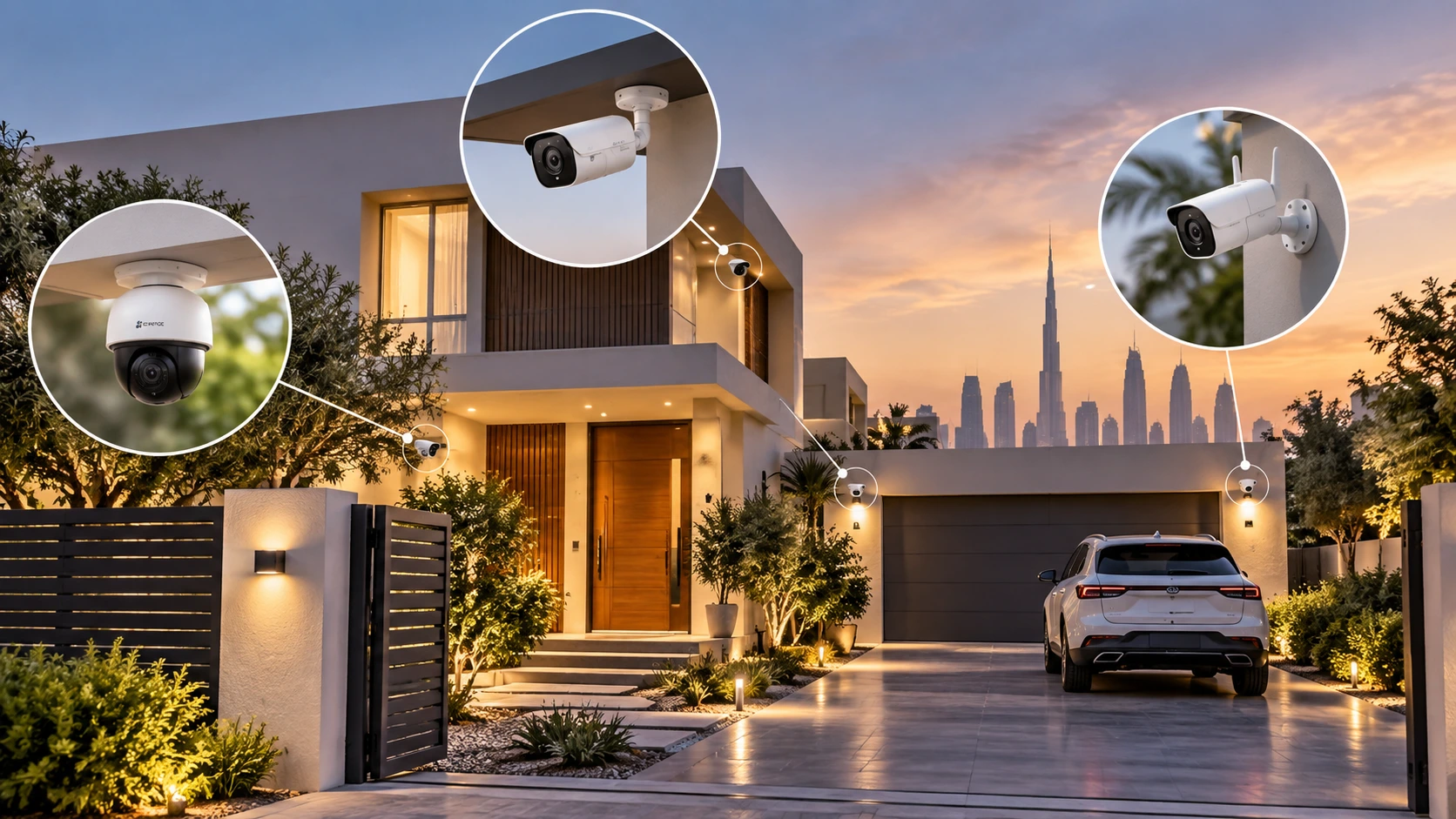
Where Should Outdoor Security Cameras Go?
Good outdoor camera placement decides whether your security system catches a clear face or just a blurry shadow. Outdoor security cameras should cover the front door, driveway, garage, back door, side entrances, gates and any other accessible area on your property. The right position gives a clear view of the path someone takes to reach your home while cutting down blind spots, glare and blocked angles.
A high-resolution camera pointed at the wrong spot still leaves gaps. Location decides how much a camera actually sees, mounting height and angle decide how much detail it captures, and your property layout decides how many cameras you need.
Quick Outdoor Camera Placement Guide
Before the full details, here is a fast reference table. Use it to check your own property in under a minute.
| Location | What to Cover | Main Goal |
| Front door | Door + approach path | Visitors and deliveries |
| Driveway | Vehicles + approach route | Vehicle and person detection |
| Garage | Garage door + surrounding area | Protect the access point |
| Back door | Door + pathway | Rear-entry monitoring |
| Side gate | Gate + narrow passage | Reduce blind spots |
| Backyard | Access routes + vulnerable areas | Perimeter coverage |
Best Places for Outdoor Security Cameras
This is the core of outdoor camera placement, and each spot on a property serves a different purpose. EZVIZ outdoor security cameras can be used across entrances, driveways, gates, parking areas and other outdoor access points. A camera at the wrong height or angle can still miss the one moment that matters.
Front Door and Porch
This is usually the best place to install an outdoor security camera, since it sees visitors, deliveries and anyone approaching the entrance. Point it at the walkway, not just the door, so it captures a person’s face while they are still approaching.
Driveway and Parking Area
Cover the full approach route, not only a parked car. Vehicle detection here flags anyone entering the property before they reach the house.
Garage and Garage Entrance
Cover the garage door and the path leading to it. This protects tools, bicycles and stored equipment along with the vehicle inside.
Back Door and Backyard
Cover the back door, patio and any rear windows. The goal is watching access points, not filming every corner of the yard.
Side Gates and Narrow Pathways
These tight spots between the front and back of a house create common blind spots. A camera here closes the gap that other cameras miss.
Accessible Windows and Vulnerable Areas
Ground-level windows hidden from street view need attention. Focus on risk, not on covering every window equally.
How High Should an Outdoor Security Camera Be Mounted?
Mounting height changes how much facial detail a camera can capture, so getting it right matters more than most homeowners expect.
Camera height depends on the lens, the field of view (FOV), the mounting surface and how much facial detail you want. A camera mounted between 8 and 10 feet (2.5 to 3 meters) works for many homes, though this range is a starting point, not a rule for every model. Mount it too low and someone can reach or tamper with it. Mount it too high and the steep angle makes faces harder to identify. Check your camera manufacturer’s installation guide, including EZVIZ’s own setup instructions, since lens angle and resolution both affect the ideal height for a specific model.
Choose the Right Camera Angle and Field of View
Angle and field of view decide whether a camera detects motion or actually identifies who caused it.
Point the camera slightly downward to capture the approach path instead of empty sky. Keep the lens clear of walls, branches or decorations that block the view, and overlap coverage between two cameras where possible to remove blind spots.
Detection and identification are different things. Detection means the camera knows something moved. Identification means the footage shows a clear face or license plate. Height, distance, angle, FOV, lighting and resolution all work together to move a camera from simple detection to real identification.
How Many Outdoor Security Cameras Do You Need?
Camera count depends on coverage, not square footage. A small home with several entry points may need more cameras than a large home with only one way in.
Count your entry points, driveway layout, side access routes, and any spot where two cameras’ fields of view don’t overlap. A property perimeter with 3 to 4 well-placed cameras and no blind spots often outperforms 8 poorly placed ones.
Outdoor Camera Placement Mistakes to Avoid
Small placement errors quietly cancel out an expensive camera system. Here are the ones homeowners repeat most.
- Mounting too high: Cuts down facial detail even with a sharp lens.
- Pointing toward direct sunlight: Strong sunlight can overexpose the image.
- Ignoring blind spots: One camera cannot watch every direction at once.
- Blocking the lens: Branches, walls and decorations reduce the field of view over time.
- Covering only the door: Miss the approach route and you miss the warning.
- Shooting through glass: Reflections and glare drop image quality fast.
- Wrong FOV choice: Too narrow leaves gaps; too wide loses detail at distance.
Lighting, Night Vision and Weather Considerations
Light and weather change what a camera can actually record, and this matters even more in a hot, dusty climate.
Porch lights and street lighting help daytime footage, while night vision and infrared (IR) handle darkness. In the UAE, intense sun, heat and dust put real stress on outdoor equipment, so a weatherproof housing with a solid IP rating (IP65 or higher) protects the camera year-round. EZVIZ cameras built for outdoor use are designed with this kind of exposure in mind. Skip guessing at a camera’s maximum operating temperature and check the manufacturer’s spec sheet instead.
Outdoor Camera Placement by Property Type
Property layout changes the priority order for outdoor camera placement.
- Villa: main gate → driveway → front entrance → side access → backyard.
- Townhouse: front entrance → parking → side or rear access.
- Large property: perimeter → gates → driveway → entrances → vulnerable areas.
- Apartment or flat: doorway and any permitted external areas, based on building rules.
Where Should You Avoid Pointing Outdoor Security Cameras?
Cameras should protect your home without recording your neighbor’s private space.
Avoid pointing a lens directly into a neighboring window, a shared private yard, or areas that add nothing to your own security. Keep the focus on entry points and approach paths on your own property, and adjust the angle if a camera drifts toward a privacy zone next door.
When installing connected cameras, it is also important to consider the security and privacy of home security cameras, including account protection, software updates and secure remote access.
How to Test Your Outdoor Camera Placement
Placement only proves itself once you check the actual footage, day and night.
Walk your normal approach routes, front and back, during daylight and after dark, then review the recording. Check face visibility, vehicle detail, motion alerts, Wi-Fi connection and any blind spot you may have missed. A five-minute walk-test catches problems a spec sheet never will.
FAQ
What is the best place to install an outdoor security camera?
The front door, driveway, garage, back door and side entrances, since these are the most common access points.
How high should an outdoor security camera be?
Most homes work well with 8–10 feet (2.5–3 m), though the exact height depends on your camera model.
Should security cameras cover the driveway?
Yes, especially when the driveway is the main approach route or vehicle entry point.
How many outdoor security cameras do I need?
It depends on your entry points, property size, and blind spots, not on square footage alone.
How do I avoid blind spots with outdoor cameras?
Overlap camera views and prioritize entry points and approach routes first.
Should an outdoor camera point toward the street?
It can, for added coverage, but keep the angle focused on your property and away from neighbors’ private space.
13. Final Thoughts
Smart outdoor camera placement comes down to strategic coverage, not simply buying more cameras. Focus on entry points, approach routes, mounting height, angle and lighting, and even a modest 3-camera setup can outperform a poorly placed 8-camera one.
Looking to set up outdoor camera placement the right way? Browse EZVIZ outdoor security cameras built for Dubai’s heat, dust and bright sun, and get coverage that actually holds up outside.
You can also explore EZVIZ Dubai for the wider range of security and smart-home products available in Dubai.